


The Complete Guide to Healthy, Strong Hips: Anatomy, Stiffness, and Injury Prevention
- Osteo Rehab
- Feb 17
- 7 min read

Most people think their hips are “tight” because of sitting or post-training soreness. The truth? Your hip is a complex, powerful, multi-directional joint designed for mobility, stability, and force transfer.
If it feels stiff or weak, it’s not broken — it’s under-prepared for the demands you place on it.
This guide will take you step by step through hip anatomy, daily function, stiffness, common injuries, and practical strategies to keep your hips moving, strong, and pain-free.
In this comprehensive hip guide, we’ll take you on a journey from understanding your hip’s design to practical strategies for pain-free movement and performance. Here’s what’s covered:
Hip Anatomy & Function – Learn how your hip joint works, including the muscles, tendons, ligaments, and labrum that provide stability and mobility.
Daily Hip Mechanics – Discover how your hips support walking, running, squatting, single-leg balance, and what happens when you sit for long periods.
Why Hips Feel Stiff – Understand the difference between true tightness and movement capacity issues, including the role of inactive glutes, shortened hip flexors, and protective nervous system responses.
Common Myths About Hip Stiffness – Debunk common misconceptions about stretching, foam rolling, and “pain-free equals ready to move.”
Actionable Exercises – Step-by-step guidance on micro-mobility, activation, and strength routines to wake up underactive muscles, restore movement, and prevent pain.
Hip Injuries in Runners & Athletes – Learn about common injuries like FAI, tendinopathies, labral tears, bursitis, and why they happen.
Movement-Based Solutions for Athletes – Practical strategies including myofascial release, stretches, mobility drills, and strength exercises to prevent injuries and improve performance.
Practical Takeaways – Quick tips to maintain healthy, strong, and pain-free hips, including daily habits, strengthening strategies, and movement awareness.
Next Steps & Support – Guidance on when to seek professional assessment and how Osteo Rehab can help you move confidently and train safely.
1. Hip Joint Anatomy: The Foundation
The hip is a ball-and-socket joint, connecting the femur (thigh bone) to the acetabulum of the pelvis. This allows movement in three planes:
Sagittal: Flexion (lifting leg forward), Extension (moving backward)


Frontal: Abduction (leg away from midline), Adduction (leg toward midline)


Transverse: Internal and external rotation


Circumduction = a compound, circular motion of the hip joint that combines flexion, abduction, extension, and adduction

Passive Structures (Stability without muscles)
Iliofemoral ligament: Prevents excessive extension; one of the strongest in the body
Pubofemoral ligament: Limits over-abduction
Ischiofemoral ligament: Limits excessive internal rotation
Joint Capsule: Surrounds the hip, adds stability, contains synovial fluid
Labrum: Cartilaginous rim around the socket; deepens the acetabulum and adds suction-stability

Active Structures (Muscles that move and stabilize the hip)
Glutes:
Maximus → hip extension, external rotation
Medius → abduction, pelvis stabilization on one leg
Minimus → assists abduction, internal rotation
Hip Flexors:
Iliopsoas → hip flexion, lumbar stabilization
Rectus femoris → assists hip flexion and knee extension
Hamstrings: Assist hip extension and deceleration
Adductors: Stabilize leg, assist medial control
Deep Rotators: Piriformis, obturator internus, gemelli → rotational stability
Visual Suggestion: Diagram of hip anatomy with active and passive structures labeled


2. How the Hip Works in Daily Life
Your hip is both load-bearing and mobile, which is why it’s involved in almost every activity:
Walking/Running: Flexion, extension, rotation every step
Squatting & Lifting: Controlled flexion, stability, and force transfer
Single-Leg Balance: Hip abductors stabilize the pelvis
Sitting/Desk Work: Hips flexed.
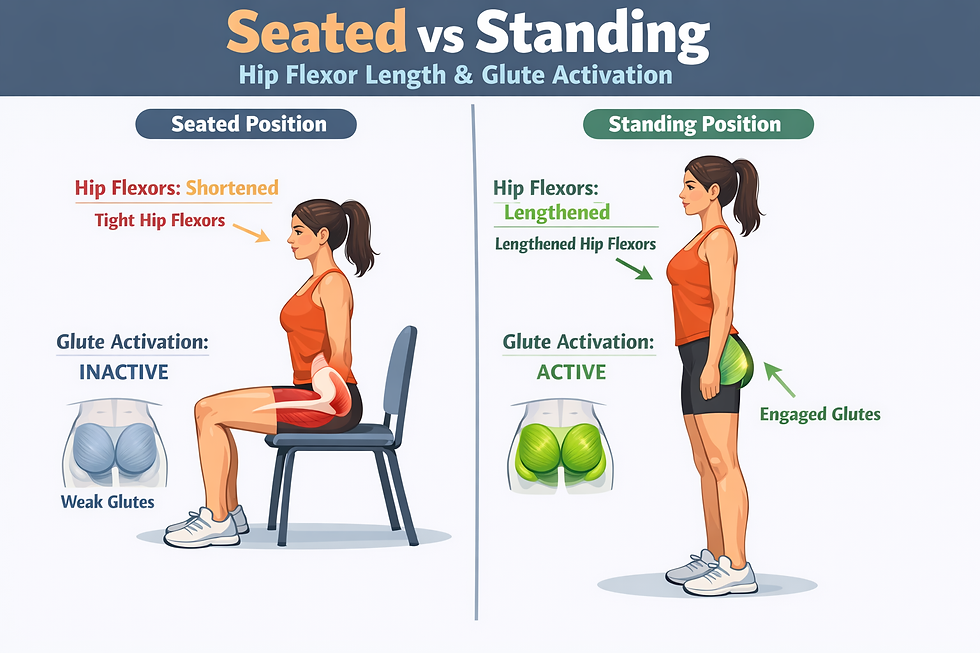
Fun Fact: Sitting for hours compresses anterior structures and shortens hip flexors, creating a “pseudo-tightness” that can limit performance in squats, deadlifts, or sprinting.
3. Why Hips Feel Stiff After Sitting
Most stiffness isn’t true “tightness” — it’s underused muscles, poor joint positioning, and load imbalance.
What happens when you sit:
Hip flexors stay shortened for hours
Glutes deactivate
Adductors & deep rotators tighten reflexively
Capsule & labrum stay compressed
The hip “locks” into a protective posture. Even when standing, your brain thinks: “We’ve been here for hours. Don’t trust full motion yet.”
Functional Consequences:
Anterior pelvic tilt → low back arch tension
Reduced hip extension → affects walking, running, squatting
Altered load transfer → knees & lumbar spine compensate
Nervous system protective tone → muscles tighten to protect weak stabilizers
Research Insight:
70% of desk workers report hip stiffness after 1–2 hours of sitting (Healthline, 2023)
Glute inactivity leads to compensatory lumbar extension & knee valgus during squats (JOSPT, 2021)
4. Common Myths About Hip Stiffness
Hip stiffness is one of the most common complaints among desk workers, athletes, and active adults alike. Unfortunately, there’s a lot of misinformation out there about how to “fix” it. Let’s break down the most common myths and why they’re misleading.
Myth 1: “Stretch more and it will go away.” ❌
Many people believe that if their hips feel tight, they just need to stretch more. The problem? Static stretching alone only lengthens muscles temporarily. It does not address the underlying weakness or inactivity in the stabilizing muscles around the hip, like the glute medius or deep rotators.
Example: You may do a 2-minute hip flexor stretch and feel relief, but when you try to squat, run, or even climb stairs, your hip still feels stiff or weak. That’s because the movement system isn’t ready, not because the muscles were “too short.”
Takeaway: Stretching is useful, but only as one part of a comprehensive routine that includes activation and strengthening.
Myth 2: “I just need foam rolling.” ❌
Foam rolling and other self-massage techniques are popular because they feel good and may temporarily reduce soreness. But they cannot replace proper movement and load tolerance. Soft tissue work addresses muscle tension, but it doesn’t wake up inactive muscles or train the hip to move efficiently under load.
Example: You foam roll your glutes and hip flexors for 5–10 minutes, feel better, but your squat still collapses inward (knee valgus) because your glute medius isn’t firing.
Takeaway: Foam rolling is a helpful warm-up tool, but without mobility drills, activation exercises, and strengthening, stiffness and compensations will persist.
Myth 3: “Pain-free means ready to move.” ❌
Just because you don’t feel pain while sitting, walking, or stretching doesn’t mean your hip is ready for loaded or athletic movement. Often, your nervous system has been protecting a joint for hours, leading to muscles that are inactive and joints that are under-prepared.
Example: You may be able to sit for hours and feel fine, but when you attempt a heavy deadlift or a sprint, your hip may limit your range of motion or cause discomfort because the muscles and ligaments haven’t been primed for load.
Takeaway: True readiness comes from mobility, activation, and strength, not just absence of pain. Think about it this way: hips aren’t “broken” just because they feel tight. Most stiffness is functional, not structural. It’s a sign that your movement system needs better coordination, stability, and load tolerance.
Addressing stiffness requires a holistic approach:
Soft tissue work to reduce restrictions
Mobility drills to restore joint control
Activation to wake up underused muscles
Strength exercises to handle everyday and athletic loads
5. Actionable Steps to Relieve & Prevent Hip Stiffness
A. Micro-Mobility (Daily)
Standing hip flexor stretch – 2x30s per side
Seated hip rotations – 1–2 min per side
90/90 hip mobility drills – 1–2 min
B. Activation (Wake Up Glutes & Stabilizers)
Glute bridges – 2x15 reps
Clamshells – 2x15 reps
Band walks – 2x20 steps each side
C. Strength & Control (Gym / Performance)
Single-leg Romanian deadlift – 2–3x10 reps
Split squats – 2–3x10 reps
Step-downs – control knee & hip alignment

6. Hip Injuries in Runners & Athletes
Sometimes stiffness turns into injury. Understanding the common issues helps prevent them.
Injury | Symptoms | Cause |
FAI (Femoroacetabular Impingement) | Groin pain, clicking, reduced ROM | Cam/pincer bone shapes, repeated hip flexion |
Hip Flexor Tendinopathy | Front hip pain during sprinting/kicking | Overuse, weak glutes, sudden volume increase |
Glute Medius/Minimus Tendinopathy | Lateral hip pain, instability | Overuse, poor single-leg mechanics |
Hamstring/Adductor Strain | Posterior/medial thigh pain | Sudden acceleration, fatigue |
Labral Tear | Groin pain, catching, clicking | Twisting, deep squats, FAI |
Trochanteric Bursitis | Lateral hip pain | Weak abductors, overuse |
Research Insight:
40–50% of athletes report hip or groin injury annually (BJSM, 2022)
FAI prevalence: ~20–25% of symptomatic athletes
Why They Happen:
Load > capacity
Weak stabilizers (glutes, deep rotators, core)
Poor mechanics: knee valgus, anterior pelvic tilt, overstriding
Overuse & fatigue

7. Movement-Based Solutions for Athletes
Goal: Restore mobility, load tolerance, and control to prevent injury recurrence
A. Soft Tissue Preparation (Myofascial Work)
Purpose: Improve tissue tolerance, increase circulation, and prepare the hips for movement.
Foam Rolling
Glutes – 60 seconds per side
Hip flexors (front of hip) – 45–60 seconds per side
Outer thigh (lateral hip region) – 45–60 seconds per side
Lacrosse Ball Release
Piriformis – 45–60 seconds per side
Deep hip rotators – 45 seconds per side
✔ Tip: Apply moderate pressure. Discomfort is okay, but avoid sharp or intense pain.
B. Dynamic Stretching
Purpose: Improve mobility while keeping the body warm and active.
Sun Salutation Flow
4–6 controlled rounds
Focus on smooth transitions and controlled breathing
Balance Quad Stretch (Standing)
10–12 reps per side
Hold each rep for 3–5 seconds
Standing Figure 4 Stretch
8–10 reps per side
Pause 2–3 seconds at the bottom
C. Mobility Drills
Purpose: Improve joint control and range of motion.
Standing Hip CARs (Controlled Articular Rotations)
5 slow circles each direction per side
Move with control, avoid compensating through the lower back
Leg Swings
Front-to-back (sagittal plane): 12–15 swings per leg
Side-to-side (frontal plane): 12–15 swings per leg
Dynamic Lunges with Rotation
8–10 reps per side
Rotate toward the front leg with control
D. Strength & Activation
Purpose: Build stability and load tolerance in the hips.
Single-Leg Hip Thrust
3 sets of 8–12 reps per side
Slow on the way down, strong squeeze at the top
Banded Lateral Shuffles
2–3 sets of 15–20 steps each direction
Maintain slight squat position throughout
Single-Leg Deadlift (BOSU or stable surface)
3 sets of 8–10 reps per side
Focus on balance and hip control
Explosive Step-Ups
3 sets of 6–8 reps per side
Drive through the heel and control the landing
Research Insight: Glute strengthening + hip mobility reduces recurrence of runner hip injuries by up to 50% (JOSPT, 2021)

8. Practical Takeaways
Don’t just stretch — activate and strengthen your hips
Include myofascial release + mobility as part of warm-up
Strengthen in multiple planes: sagittal, frontal, transverse
Monitor movement patterns: avoid knee valgus, excessive anterior pelvic tilt, hip internal rotation collapse
Seek professional assessment for persistent pain
9. Next Steps & Support
Hip stiffness and pain are not inevitable — they’re often a capacity and movement problem.
At Osteo Rehab in Toronto, we assess hip mechanics, identify weak links, and design personalized mobility and strength programs so you can train, run, and lift pain-free and performance-ready.


Comments